If you are registered for sales tax, the single biggest number in your monthly return is not your sales — it is the input tax you are allowed to subtract. Claim it correctly and you pay sales tax only on the value you add. Claim it wrongly and FBR can disallow it, add default surcharge and impose a penalty.
This guide explains input tax adjustment under the Sales Tax Act, 1990 as amended by the Finance Act 2026: what you can claim (Section 7), the 90% limit (Section 8B), what you can never claim (Section 8) and the banking-channel rule that catches many small businesses (Section 73).
- Input tax = sales tax you paid on business purchases and imports. Output tax = sales tax you charged on your sales.
- You pay: output tax − admissible input tax (Section 7).
- Adjustable input tax is capped at 90% of output tax each month (Section 8B) — but not for capital goods from the Finance Act 2026.
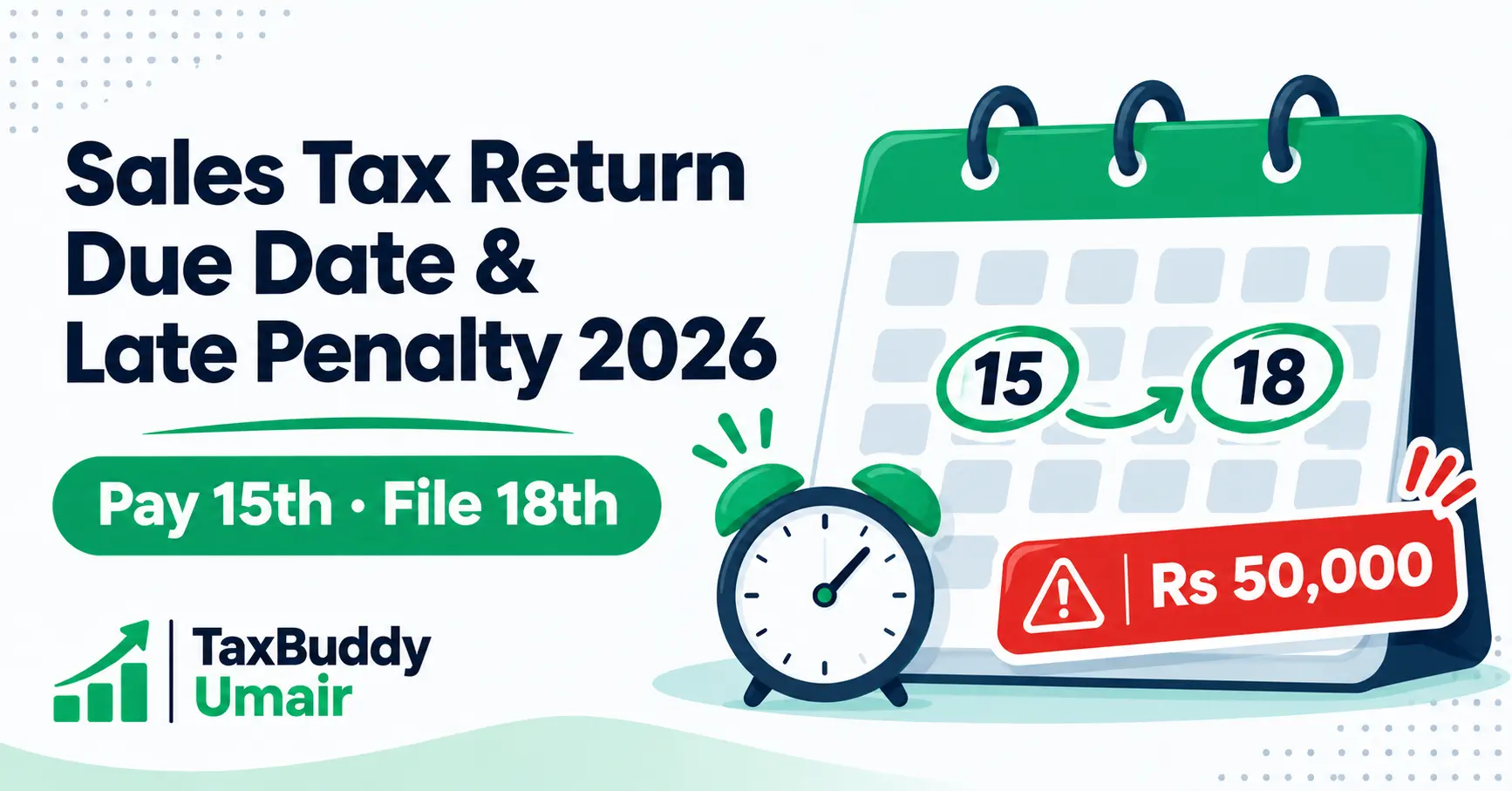
- Paying a supplier more than Rs 50,000 in a tax period in cash kills the input tax claim (Section 73).
- Missed a claim? You can still take it in any of the next six tax periods.
1. What is input tax and output tax?
The Sales Tax Act defines input tax (Section 2(14)) as sales tax paid on goods and services purchased or imported by a registered person, and output tax (Section 2(20)) as the sales tax charged on the taxable supplies he makes. Section 7 then lets the registered person deduct the input tax from the output tax due for the same tax period.
The idea is simple: the government should collect 18% only on the value each business adds in the supply chain, not on the full price at every stage.
| Term | Meaning |
|---|---|
| Input tax | Sales tax on your purchases and imports for business (Section 2(14)) |
| Output tax | Sales tax you charge on your taxable supplies (Section 2(20)) |
| Tax payable | Output tax − admissible input tax (Section 7) |
2. The four conditions to claim input tax (Section 7)
Under Section 7(2), input tax can be deducted only if you hold the right document:
- Local purchase: a tax invoice in your name and bearing your registration number. For electricity and gas, the bill must carry your registration number and the address of the connection.
- Imports: a goods declaration (bill of entry) in your name showing your sales tax registration number, cleared by Customs.
- Auction purchases: a treasury challan in your name and registration number showing payment of sales tax.
Two more conditions apply on top of the document:
- The purchase must be used, or be meant to be used, for taxable supplies made by you (Section 7(1) and 8(1)(a)).
- Your supplier must actually declare the sale and pay the tax. Section 8(1)(ca) disallows input tax where the supplier has not deposited the tax, and Section 8(1)(caa) disallows purchases flagged as a discrepancy by FBR's CREST system or not verifiable in the supply chain.
3. The 90% limit — Section 8B
Section 8B(1) says a registered person cannot adjust input tax of more than 90% of the output tax for a tax period. In practice this means every registered person pays at least 10% of output tax each month, even if purchases were heavy.
Important points from the current text:
- Capital goods are outside the limit. A proviso added by the Finance Act 2026 says the 90% restriction does not apply to fixed assets or capital goods.
- The blocked amount is not lost. Under the first proviso to Section 10(1), input tax that is not adjustable because of Section 8B(1) is carried forward to the next tax period together with any other excess input tax, and treated as input tax for that period. In addition, Section 8B(2) and (3) allow a yearly adjustment or refund, in the second month after the end of the financial year, where value addition is actually below the limit — for companies with audited accounts on an auditor-certified statement; for others, under conditions notified by the Board.
- FBR can change the limit for you. The Board may raise or lower the limit for a person depending on compliance with digital invoicing, POS and other electronic systems, and may use its automated risk system to defer input tax (Section 8B(4)). You can contest such action before the Commissioner, who must decide within 30 days.
- Tier-1 retailers who are not POS-integrated lose 60% of the adjustable input tax for the whole tax period (Section 8B(6)).
Example — Mr. Bilal, a distributor in Lahore
In October 2026, Mr. Bilal's sales carry output tax of Rs 1,000,000. His purchases from registered suppliers carry input tax of Rs 950,000, all on stock for resale.
| Working | Amount |
|---|---|
| Output tax | Rs 1,000,000 |
| Input tax paid | Rs 950,000 |
| Maximum adjustable (90% of output tax) | Rs 900,000 |
| Sales tax payable for October | Rs 100,000 |
| Input tax held back by Section 8B | Rs 50,000 — carried forward to November as input tax (first proviso, s.10(1)); yearly adjustment/refund route under s.8B(2)–(3) |
Now suppose that in the same month Mr. Bilal also bought a packing machine with input tax of Rs 200,000. Because it is a capital good, the Finance Act 2026 proviso keeps it outside the 90% cap, so he can adjust it in addition to the Rs 900,000.
4. Input tax you can never claim — Section 8
Section 8(1) lists purchases on which input tax is not admissible, whatever invoice you hold:
| Disallowed input tax | Clause |
|---|---|
| Goods or services used for anything other than your taxable supplies | 8(1)(a), (f) |
| Goods subject to extra tax under Section 3(5) | 8(1)(c) |
| Purchases where the supplier did not deposit the tax, or CREST shows a discrepancy | 8(1)(ca), (caa), (l) |
| Fake invoices | 8(1)(d) |
| Personal or non-business consumption | 8(1)(g) |
| Building and construction materials, paint, electrical and sanitary fittings, pipes, wires and cables attached to immovable property (unless bought for resale or used directly in manufacturing) | 8(1)(h) |
| Vehicles and their parts, electrical and gas appliances, furniture, furnishings, office equipment (except electronic cash registers), unless bought for resale | 8(1)(i) |
| Services whose input adjustment is barred under the provincial sales tax law | 8(1)(j) |
| Agricultural machinery taxed at the 7% reduced rate (Eighth Schedule) | 8(1)(k) |
| Inputs attributable to supplies to unregistered distributors where the invoice does not carry the buyer's CNIC/NTN (pro-rata) | 8(1)(m) |
Mixed businesses: if you make both taxable and exempt supplies, Section 8(2) allows only the share of input tax that relates to taxable supplies, worked out in the manner set by the Board.
Example — Mr. Kamran's new car
Mr. Kamran runs a registered garment factory. He buys a car for his sales manager and receives a proper sales tax invoice in the company's name. The input tax on the car is still not admissible — Section 8(1)(i) disallows vehicles unless they are bought for resale. The input tax on the fabric, thread and the new stitching machines, on the other hand, is admissible.
5. The cash payment trap — Section 73
Section 73 is where many small and medium businesses lose input tax without realising it.
Section 73(2): if you do not, you cannot claim the input tax, refund or zero-rating on that purchase. For credit purchases, the payment must be made this way within 180 days of the invoice.
For the full rule — what counts as a banking channel, the 180-day credit window and how to set off payables — read our detailed guide on the Section 73 bank payment rule.
The "business bank account" is the account you declared to FBR in your registration (Form STR-1) or through a change of particulars. Payments from a personal account do not qualify. Setting off amounts payable and receivable with the same party counts as payment only with the Commissioner's prior approval and if both sides charged and paid sales tax.
Example — Sara's furniture workshop
Sara buys wood worth Rs 400,000 plus sales tax of Rs 72,000 from a registered timber supplier in three cash instalments during November 2026. Because her payments to that one supplier exceed Rs 50,000 in the tax period and were not made through her business bank account, she loses the Rs 72,000 input tax under Section 73(2). Had she paid by online transfer from her declared business account, the full Rs 72,000 would have been adjustable (subject to the 90% limit).
6. Common mistakes that cost input tax
- Invoice in the wrong name or without your registration number — Section 7(2)(i) makes the claim inadmissible.
- Buying from a supplier who does not file or pay — your claim fails under Section 8(1)(ca) and (l), even with a valid invoice. Check the supplier's status before large purchases.
- Paying cash or from a personal account — Section 73 (see the Section 73 bank payment rule).
- Claiming on cars, furniture, construction material and appliances — Section 8(1)(h) and (i).
- Forgetting the 90% limit — budget for paying at least 10% of output tax every month, except for capital goods.
- Waiting too long — late claims are allowed only within six succeeding tax periods.
Summary
| Rule | What it means | Section |
|---|---|---|
| Right to adjust | Deduct input tax from output tax for the same period | 7(1) |
| Documents | Invoice / GD / challan in your name and registration number | 7(2) |
| Late claim | Within the next six tax periods | 7(1) proviso |
| 90% limit | Max 90% of output tax; capital goods excluded (FA 2026) | 8B |
| Disallowed items | Vehicles, furniture, construction material, personal use, fake invoices, unpaid supplier tax | 8 |
| Banking channel | Over Rs 50,000 per supplier per period must go through the business bank account | 73 |
| Tier-1 not POS-integrated | Input tax reduced by 60% for the period | 8B(6) |
Frequently asked questions
What is input tax in sales tax?
Input tax is the sales tax a registered person pays on purchases and imports used for making taxable supplies. Under Section 7 it is deducted from the output tax on sales, so tax is paid only on the value added.
Can I adjust all my input tax against output tax?
No. Section 8B limits adjustable input tax to 90% of output tax for a tax period. From the Finance Act 2026 the limit does not apply to fixed assets or capital goods. Input tax blocked by the limit is carried forward to the next tax period under the first proviso to Section 10(1), and Section 8B(2)–(3) also allow yearly adjustment or refund where value addition is below the limit.
Can I claim input tax if I paid the supplier in cash?
Not if your payments to that supplier exceed Rs 50,000 in aggregate in the tax period. Section 73 requires a crossed banking instrument, online transfer from the business account or credit card.
I forgot to claim input tax in last month's return. Is it lost?
No. You can claim it in the return for any of the six succeeding tax periods (proviso to Section 7(1)).
Can I claim input tax on a car or office furniture?
No. Section 8(1)(i) disallows vehicles, their parts, appliances, furniture, furnishings and office equipment (except electronic cash registers), unless you buy them for resale.

💬 Comments 0
No comments yet. Be the first to share your thoughts!
✍️ Leave a Comment
Your comment will be reviewed before publishing. Please keep it relevant and respectful.