Introduction
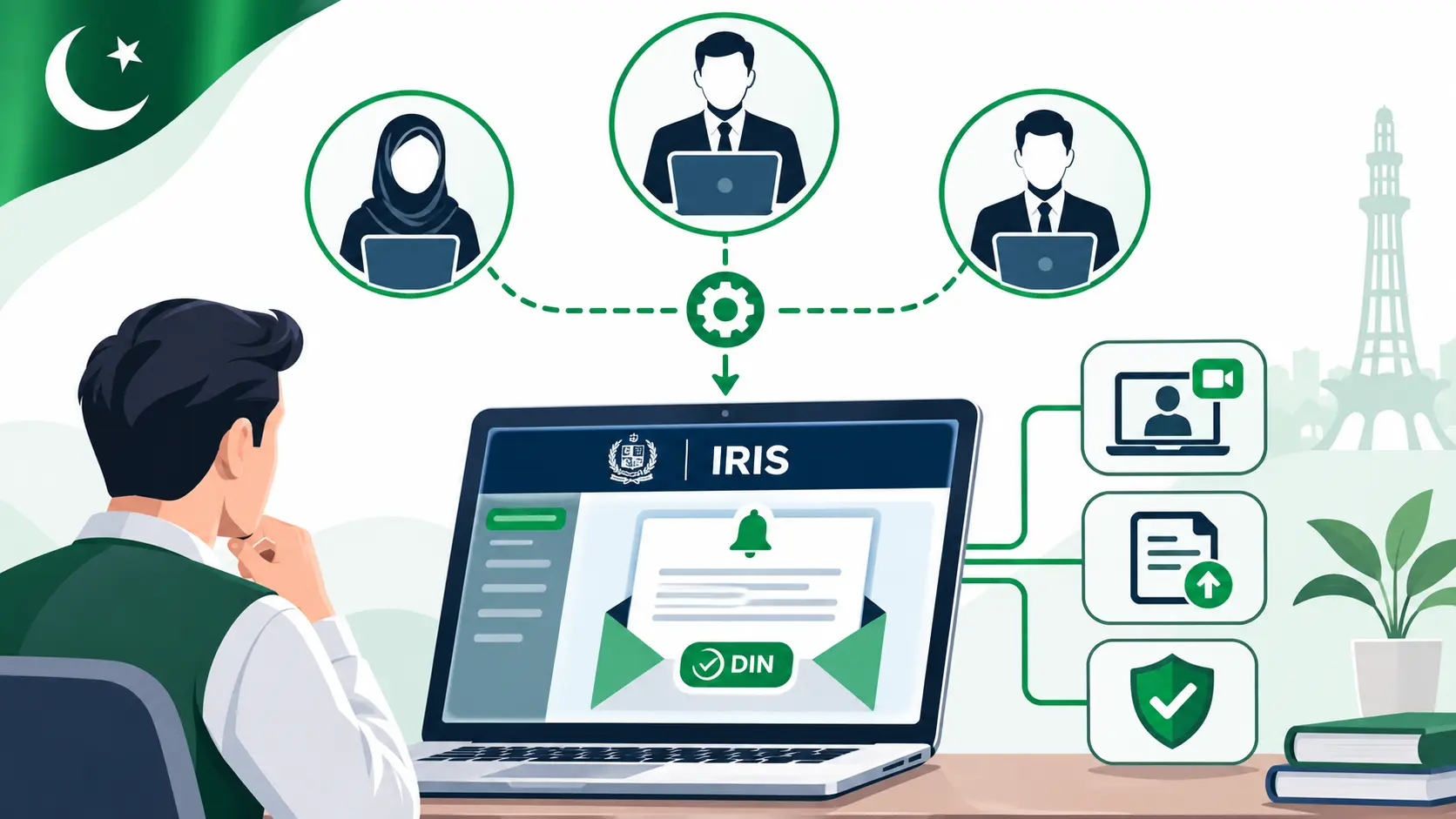
FBR is no longer waiting for an officer to open your file. Its automated system now reads income tax returns, cross-matches them with data FBR already holds, and sends you a message on IRIS when something does not add up.
The legal procedure for this was finalised through S.R.O. 2098(I)/2026, which inserts a new Rule 38B into the Income Tax Rules, 2002. This guide explains what the rule says, what gets flagged, how much time you get, and how to respond.
In short: If FBR's system finds a mistake or mismatch in your return, you get an advance intimation on IRIS with at least 7 days to explain or correct it. Ignore it and a reminder follows with another 7 days. After that, the officer decides whether to take action under the Ordinance.
What Is SRO 2098(I)/2026?
| Item | Detail |
|---|---|
| Notification | S.R.O. 2098(I)/2026, dated 10 November 2026 — F. No. 1(53)S(ITP)/2026 |
| Draft | S.R.O. 1690(I)/2026, dated 6 October 2026, published for objections under Section 237(3) |
| What it does | Inserts Rule 38B after Rule 38A of the Income Tax Rules, 2002 |
| Title of the rule | Procedure for electronic scrutiny and intimation of issues detected by the automated system |
| Legal basis | Section 120(2A) read with Section 237(1) of the Income Tax Ordinance, 2001 |
| Applies to | Returns of income processed by FBR's automated system (including CRM) under Section 120(2A) |
The Law Behind It — Section 120(2A)
Section 120(2A) of the Ordinance says a return filed under Section 114(2) shall be processed through an automated system to arrive at the correct total income, taxable income and tax payable, by making adjustments for:
- (i) any arithmetical error in the return;
- (ii) any incorrect claim apparent from information in the return;
- (iii) disallowance of any loss, deductible allowance or tax credit; and
- (iv) disallowance of carry forward of a loss under Section 182A(1)(b) (late filers).
Section 120(7) explains these terms. An arithmetical error includes a wrong calculation of tax payable, including minimum or final tax. An incorrect claim apparent from the return means an entry that:
- is inconsistent with another entry in the same return;
- claims a tax payment that is not verified from FBR's collection system; or
- claims a deduction above a statutory limit (an amount, percentage, ratio or fraction).
Rule 38B adds the procedure: how the system tells you about an issue, how long you get, and what the officer does next.
How Rule 38B Works — Step by Step
- Automated scrutiny — sub-rule (1): FBR's automated system, including CRM, scrutinises, analyses and cross-matches your return with other information available to FBR.
- Advance intimation — sub-rules (2) & (3): If it detects a factual or legal mistake or a discrepancy, the system sends an online advice / advance intimation through IRIS. The same system-generated intimation can also be sent by the jurisdictional Officer of Inland Revenue.
- Your reply — sub-rule (4), minimum 7 days: You can explain, correct the error, or take other corrective action within the period given.
- Reminder — sub-rule (5), minimum 7 more days: If you do not reply, the system sends a reminder with a further period of at least seven days.
- Record and dashboard — sub-rules (6)–(8): The issue, the intimation and your reply are communicated to the jurisdictional officer and recorded on the system's dashboard. The procedure is implemented through a Change Request Form (CRF).
- Officer's decision — sub-rule (9): The officer reviews your reply, or notes that none came, and decides whether action is needed under the Ordinance and the Rules.
| Stage | Time allowed |
|---|---|
| Advance intimation on IRIS | At least 7 days |
| Reminder if no reply | At least 7 more days |
| Shortest total window | About 14 days from the first intimation |
Not a penalty. An intimation is not an assessment order or a penalty notice. Its stated purpose is to let you resolve the issue before legal or penal proceedings start. But if you ignore it, the officer can move to the normal provisions of the Ordinance.
What Is Likely to Get Flagged?
Rule 38B itself does not list specific triggers. Based on Section 120(2A) and 120(7), and the data FBR already holds, typical mismatches include:
| Mismatch | Example |
|---|---|
| Tax credit not in FBR's collection system | You claimed Rs 80,000 withholding tax, but only Rs 50,000 appears against your CNIC/NTN |
| Salary or income lower than third-party data | Employer's Section 165 withholding statement shows higher salary than declared |
| Wrong tax calculation | Wrong slab applied, or minimum/final tax not computed |
| Deduction above the limit | Donation or pension-fund credit claimed above the statutory ceiling |
| Inconsistent entries | Property or vehicle bought (advance tax paid under 231B/236K) but not shown in the wealth statement |
| Late return | Business loss carried forward although the return was filed late (Section 182A) |
How to Respond
- Check IRIS regularly and keep your registered mobile number and email updated, because intimations are electronic.
- Read the issue carefully. Is it a genuine error, or is FBR's data wrong (for example, a withholding agent did not file its statement)?
- If FBR's data is wrong: reply with evidence — tax deduction certificates, CPRs, bank statements, the employer's certificate.
- If your return is wrong: correct it. A revised return under Section 114(6) is the formal way (see below).
- Reply within the time given. Do not wait for the reminder.
Revising Your Return — Section 114(6)
If you discover an omission or wrong statement, Section 114(6) allows a revised return, accompanied by revised accounts (the Commissioner can waive this) and signed reasons for revision.
| Situation | Commissioner's approval |
|---|---|
| Revised within 60 days of filing the original return | Not required |
| Revised return declares more income / less loss than determined under Section 120 | Deemed granted |
| Any other case | Required — deemed granted if not decided within 60 days of the request; must be granted for a bona fide omission |
The Finance Act 2026 also added Section 134B — algorithmic settlement mechanism. Under it, FBR's system may offer a settlement amount before an assessment under Sections 121, 122 or 122E. If you accept it on IRIS within 10 days, deposit the amount and revise your return, the issues raised in that proceeding stand abated.
Sales Tax Has the Same System
A matching procedure already applies to sales tax. S.R.O. 1655(I)/2026 (25 September 2026) inserted Chapter XII-A (Rules 150HA and 150HB) into the Sales Tax Rules, 2006, under Section 50B of the Sales Tax Act 1990. The system cross-matches sales tax returns and sends an advance intimation on IRIS with the same minimum 7 days, plus a 7-day reminder.
FAQs
Q1: Does an intimation mean FBR has selected me for audit?
No. It is an early alert about a specific issue. Audit selection under Section 177 or a faceless audit under Section 122E is a separate process.
Q2: What if I don't reply at all?
You get a reminder with at least 7 more days. If you still don't reply, the officer reviews the matter without your input and may take action under the Ordinance, such as an amendment of assessment under Section 122.
Q3: Who sends the intimation — a person or the system?
Both are possible. The automated system can send it, and the jurisdictional Officer of Inland Revenue can also send an advance intimation through IRIS.
Q4: My employer deducted tax but did not deposit it. What do I do?
Reply with your salary tax certificate and payslips showing the deduction. The responsibility to deposit the tax and file statements lies with the withholding agent.
Q5: How does this relate to the 30-day notice in Section 120(2A)?
Section 120(2A) separately requires a system-generated notice before any automatic adjustment, with 30 days to respond. Rule 38B does not explain how its 7-day intimation fits with that 30-day notice. The 7-day intimation appears to be an earlier step, but wait for FBR's guidance on this.
Conclusion
Rule 38B makes FBR's automated scrutiny official: the system flags errors, you get at least 7 days plus a 7-day reminder on IRIS to fix them, and only then does the officer decide on action. File accurate returns, make sure every tax credit you claim actually appears in FBR's system, match your wealth statement to the assets FBR knows about, and check your IRIS inbox.
Sources & References
- S.R.O. 2098(I)/2026 dated 10 November 2026 — Rule 38B, Income Tax Rules, 2002 (draft S.R.O. 1690(I)/2026 dated 6 October 2026)
- Income Tax Ordinance 2001 — Sections 114(6), 120(2A), 120(7), 122, 134B, 177, 182A, 237
- S.R.O. 1655(I)/2026 — Rules 150HA and 150HB, Sales Tax Rules, 2006
- Federal Board of Revenue — fbr.gov.pk
Disclaimer: This article is for educational purposes only and reflects the Income Tax Ordinance 2001 as amended by the Finance Act 2026 and Rule 38B as notified on 10 November 2026. This does not constitute professional tax advice.
Got an advance intimation on IRIS and not sure how to reply? Get help from Umair Mubeen — Pakistan tax educator, Karachi. WhatsApp: +92 333 248 2742


💬 Comments 0
No comments yet. Be the first to share your thoughts!
✍️ Leave a Comment
Your comment will be reviewed before publishing. Please keep it relevant and respectful.