Every year thousands of Pakistanis ask the same question before buying a plot, registering a car, or withdrawing a large amount from the bank: should I become a filer? The honest answer is that being a non-filer is now one of the most expensive habits in Pakistan — often costing several times more tax on the exact same transaction.
This guide explains, in plain terms, what a filer, a late-filer, and a non-filer actually are, the exact withholding tax difference for Tax Year 2026–27 (as per the Finance Act, 2026), and the simple steps to get your name onto the FBR Active Taxpayers List (ATL).
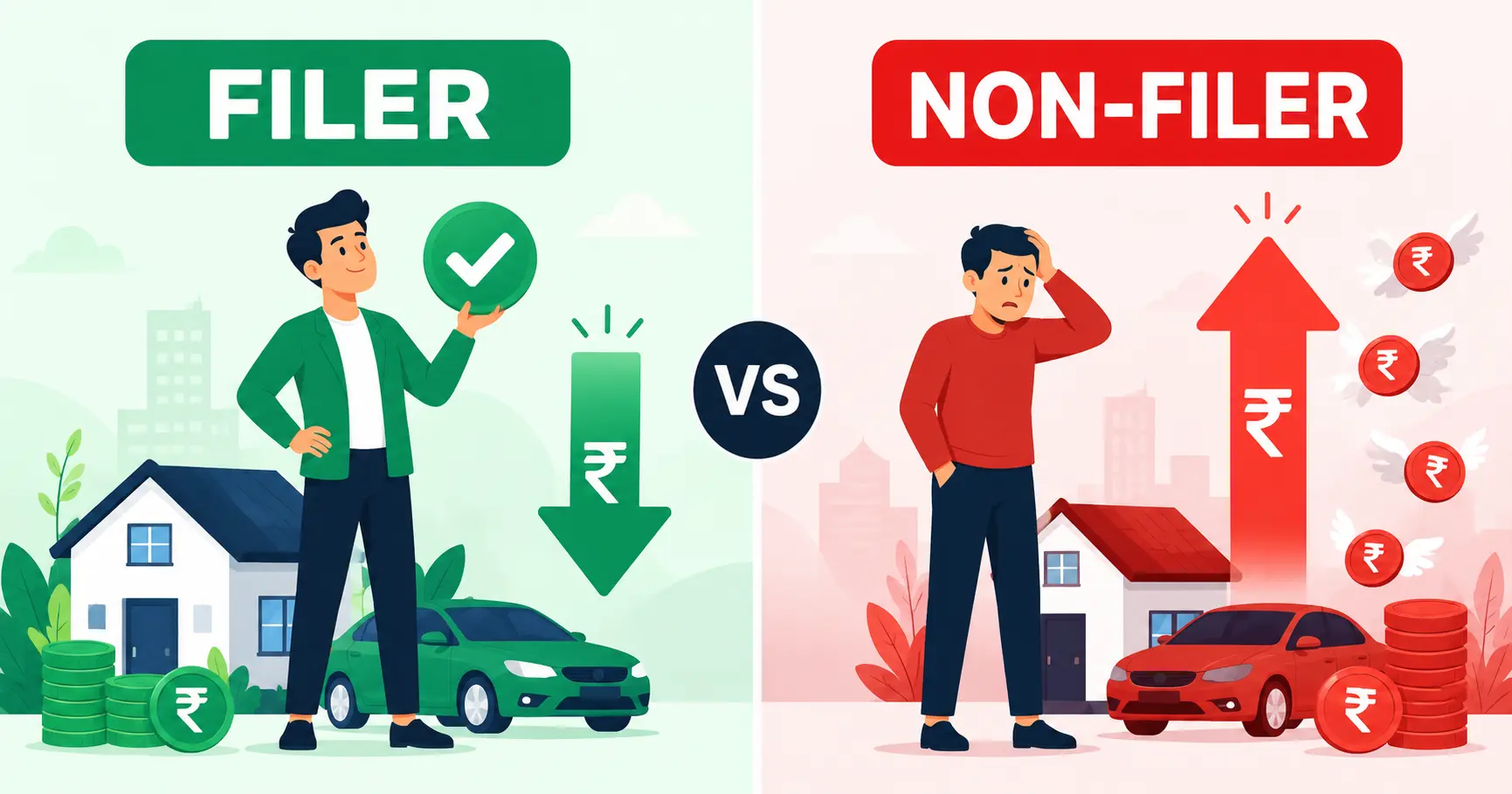
In one line: A filer is a person whose name appears on the FBR Active Taxpayers List (ATL) after filing their income tax return on time. A non-filer is everyone else — and the Ordinance charges them sharply higher rates on a long list of everyday transactions.
What changed in Finance Act 2026: property withholding tax was cut and simplified. The old value-based slabs for filers are gone — sellers now pay a flat 2.75% under Section 236C (down from 3%), and buyers pay a flat 1.25% under Section 236K (down from 3%), whatever the property is worth. Non-filer rates stay high.
What is a Filer? Understanding the ATL
“Filer” is not a separate registration. It simply means your name is on the Active Taxpayers List (ATL), which the FBR publishes and updates regularly. You land on the ATL by registering for a National Tax Number (NTN) and filing your annual income tax return for the relevant tax year. Miss the deadline and you either drop off the list or fall into the late-filer category — which can carry higher rates than an on-time filer.
You can check your own status for free in seconds using our ATL Status Check tool, or by sending an SMS to 9966 (type ATL space CNIC). If your CNIC shows as “Active”, you are a filer for that tax year.
Filer vs Non-Filer Tax Rates (2026–27)
Here is where the difference becomes real money. The table below shows the withholding tax rates on the transactions people ask about most, taken directly from FBR's Withholding Tax Rate Card updated to 30 June 2026 under the Finance Act, 2026.
| Transaction (Section) | Filer (ATL) | Non-Filer |
|---|---|---|
| Selling property — any value (236C) | 2.75% | 11.5% |
| Buying property — FMV up to Rs 50M (236K) | 1.25% | 10.5% |
| Buying property — FMV Rs 50M–100M (236K) | 1.25% | 14.5% |
| Buying property — FMV above Rs 100M (236K) | 1.25% | 18.5% |
| Cash withdrawal over daily limit (231AB) | Nil | 0.8% |
| Profit on bank deposits (151) | 20% | 40% |
| Dividend income — general (150) | 15% | 30% |
| Vehicle registration — 1001–1300cc (231B) | 1.5% | 4.5% |
Two patterns jump out. First, for most transactions the non-filer rate is exactly double the filer rate — and for vehicle registration it is triple — because the Tenth Schedule of the Ordinance increases the deduction for people not on the ATL. Second, property is where the gap is widest: after the Finance Act 2026 cuts, a filer buying property pays just 1.25%, while a non-filer can pay up to 18.5% — roughly fifteen times more on high-value property.
This table covers only the most common transactions. For the complete, section-by-section list, see our full Withholding Tax Rates 2026-27 guide.
Where Being a Non-Filer Hurts the Most
1. Property Purchase and Sale
Property is the single biggest pain point. Under Section 236K, a filer buying property now pays just 1.25% advance tax at every value, while a non-filer pays 10.5% to 18.5% on the same purchase depending on the value slab. On the sale side, Section 236C charges a filer a flat 2.75% of the gross consideration, against a flat 11.5% for a non-filer.
Worked example — buying a Rs 30 million plot (Section 236K)
Filer: 1.25% of Rs 30,000,000 = Rs 375,000
Non-filer: 10.5% of Rs 30,000,000 = Rs 3,150,000
Extra cost of staying a non-filer: Rs 2,775,000 — on a single transaction.
Want the exact figure for your own case? Use our Withholding Tax Card calculator — it works out the WHT and advance tax for any transaction and tells you whether the tax is fixed, minimum, or adjustable. You can also work out the FBR value your tax is charged on with the Karachi FMV Calculator.
2. Cash Withdrawals
Under Section 231AB, banks deduct 0.8% advance tax on cash withdrawals above Rs 50,000 per day for people not on the ATL. Filers face no such deduction. For anyone who handles cash for a business, this quietly adds up over a year.
3. Motor Vehicles
For vehicle registration under Section 231B, the non-filer rate is exactly three times the filer rate at every engine-capacity slab — for example, 1.5% versus 4.5% for a 1001–1300cc car. Annual token tax under Section 234 is similarly far higher for non-filers.
4. Savings and Investments
Profit on bank deposits (Section 151) is taxed at 20% for filers but 40% for non-filers. Dividends (Section 150) are taxed at 15% for filers and 30% for non-filers. If you keep money in a savings account or invest in shares and mutual funds, filer status directly protects your returns.
The “Late-Filer” — A Third Category You Should Know
Since the Finance Act 2024, there is a middle tier. A late-filer is someone who is on the ATL but filed their return after the due date. Late-filers sit between on-time filers and non-filers.
Note that the Finance Act 2026 simplified property withholding tax into flat filer and non-filer rates — the value-based slabs that used to define separate late-filer property rates were removed. The late-filer status still matters across the tax system, and filing on time remains the only way to secure the lowest rate. Always confirm the exact rate for your transaction on our up-to-date Withholding Tax Rates 2026-27 page before you transact.
The lesson: filing is good, but filing on time is what keeps you on the ATL and gets you the lowest rate. Filing late — or not at all — still costs you two to three times more.
How to Become a Filer in Pakistan
Getting on the ATL is more straightforward than most people expect:
- Register for an NTN. Sign up on the FBR IRIS portal (iris.fbr.gov.pk) using your CNIC and basic details. For salaried individuals the CNIC itself works as the NTN.
- File your income tax return. Select the correct return form for the tax year, declare your income and assets (wealth statement), and submit before the deadline — usually 30 September.
- Pay any tax due. If tax is payable after adjusting what was already deducted, pay it before submitting.
- Appear on the ATL. Once your return is accepted and the list is updated, your CNIC shows as “Active”. You can confirm this anytime using our ATL Status Check tool. You are now a filer.
If you have already paid extra tax as a non-filer during the year, much of that is adjustable or refundable once you file — so becoming a filer can put money back in your pocket, not just save it going forward.
Frequently Asked Questions
What is the difference between a filer and a non-filer in Pakistan?
A filer is a person whose name appears on the FBR Active Taxpayers List (ATL) after filing their income tax return on time. A non-filer is not on the ATL and pays withholding tax at much higher rates — usually double, and on property several times more — on transactions like property, vehicles, cash withdrawals, and bank profit.
How much more tax does a non-filer pay on buying property in 2026–27?
On purchase of immovable property under Section 236K for 2026–27, a filer pays a flat 1.25% of the fair market value, while a non-filer pays 10.5% to 18.5% depending on the value slab — up to about fifteen times more on high-value property.
What is the 236C rate for sellers in 2026–27?
Under the Finance Act 2026, Section 236C on the sale/transfer of immovable property is a flat 2.75% for filers (down from the earlier value-based slabs) and 11.5% for non-filers, charged on the gross consideration. 236C is an adjustable advance tax — filers can claim it back against their annual tax liability.
How do I become a filer in Pakistan?
Register on the FBR IRIS portal at iris.fbr.gov.pk using your CNIC to get your NTN, file the relevant income tax return for the tax year, and once it is accepted your name is added to the Active Taxpayers List after the ATL is next updated.
Do non-filers pay advance tax on cash withdrawals?
Yes. Under Section 231AB, banks deduct 0.8% advance tax on cash withdrawals exceeding Rs 50,000 per day from persons not on the ATL. Filers are not subject to this deduction.
Disclaimer: This article is for educational purposes only and reflects FBR's Withholding Tax Rate Card updated to 30 June 2026 (Finance Act, 2026 — Tax Year 2026-27). Rates change through Finance Acts and FBR notifications. Always verify from FBR's official portal at fbr.gov.pk or consult a qualified tax practitioner.


💬 Comments 0
No comments yet. Be the first to share your thoughts!
✍️ Leave a Comment
Your comment will be reviewed before publishing. Please keep it relevant and respectful.