Introduction
One of the most important but frequently overlooked rights of every taxpayer in Pakistan is the right to claim a refund of excess income tax. Throughout the year, tax is deducted at source from salaries, bank profits, property transactions, dividends, and countless other payments. In many cases, the total tax deducted at source exceeds the taxpayer's actual annual tax liability — and that excess belongs to the taxpayer, not the government.
Section 170 of the Income Tax Ordinance, 2001 establishes the legal framework through which taxpayers can formally claim refunds of overpaid income tax. It prescribes who can claim, how to apply, what the Commissioner must do with the application, within what timeframe, and what options are available if the application is rejected or not decided.
Understanding Section 170 is essential for salaried employees, business owners, investors, and anyone who has had excess withholding tax deducted during the year and wishes to recover it.
Key Point: A refund under Section 170 is your legal right — not a favour granted by the tax department. If you have overpaid income tax, the law requires the Commissioner to refund it within 60 days. Non-compliance by the department entitles you to file an appeal.
Legal Basis — Section 170, Income Tax Ordinance, 2001
Section 170 of the Income Tax Ordinance, 2001 is titled "Refunds" and is the primary provision governing the recovery of excess income tax paid by taxpayers in Pakistan. It creates a structured process for refund applications — with clear rights and obligations for both the taxpayer and the Commissioner of Income Tax.
Section 170 covers all forms of income tax overpayment, including:
- Excess withholding tax deducted at source during the year (salary tax, Section 151, Section 236Y, Section 236C, Section 236K, and other withholding provisions)
- Excess advance tax paid during the year
- Excess tax resulting from a revised assessment that reduces the tax liability compared to what was originally assessed and paid
- Tax paid in excess due to erroneous double payment
- Tax refundable where an advance or loan treated as dividend under Section 2(19)(e) is subsequently repaid
1. Who Is Eligible to Apply for a Refund?
Any taxpayer who has paid income tax in excess of their actual liability under the Income Tax Ordinance, 2001 is eligible to apply for a refund under Section 170. The eligibility is broad and inclusive — covering individuals, companies, associations of persons (AOPs), and any other taxable entity.
Category 1 — Excess Tax Paid During the Year
The most common basis for a refund is where the total tax deducted at source and advance tax paid during the year exceeds the final income tax liability as calculated in the annual return. Examples include:
- A salaried employee whose employer deducted more tax than necessary during the year
- An investor who had 20% withholding on bank profit (Section 151) but whose marginal tax rate is lower than 20%
- A property seller who had Section 236C advance tax deducted but whose CGT liability is lower than the deducted amount
- A business person who paid quarterly advance tax that exceeds their final tax liability for the year
- A cardholder who had Section 236Y deducted on international payments that exceeds their annual liability
Category 2 — Advance or Loan Repaid (Section 2(19)(e) Dividend)
Under Section 2(19)(e) of the Income Tax Ordinance, 2001, certain loans or advances taken by shareholders from their companies are treated as deemed dividends and taxed accordingly. If such a loan or advance is subsequently repaid, the tax paid on it becomes refundable — since the underlying transaction (the deemed dividend) has been reversed. Section 170 allows the taxpayer to apply for this refund.
2. Application Requirements
A refund application under Section 170 must meet specific formal requirements. Failure to comply with these requirements can result in the application being rejected on procedural grounds.
Who to Submit To
The refund application must be submitted to the Commissioner of Income Tax having jurisdiction over the taxpayer. For most individuals and businesses, this is the Commissioner at the Regional Tax Office (RTO) or Large Taxpayer Office (LTO) where the taxpayer's file is maintained.
Refund applications for income tax are submitted through FBR's IRIS portal (iris.fbr.gov.pk) — where the annual income tax return itself serves as the primary refund application for excess withholding tax. For refunds arising from other circumstances, a separate application in the prescribed form may be required.
Prescribed Form and Verification
The application must be:
- Submitted in the prescribed form as specified by FBR under the Income Tax Rules, 2002
- Verified in the prescribed manner — typically through the taxpayer's digital signature or verification via FBR IRIS
- Accompanied by all relevant supporting documentation, including:
- Annual income tax return for the relevant year
- Tax deduction certificates from employers (for salary tax)
- Bank statements and withholding certificates from banks (for Section 151)
- Property registration documents and Section 236C/236K deduction evidence
- Any other documents supporting the excess payment claim
Time Limit — Three Years
This is one of the most critical requirements — and the one most commonly missed by taxpayers. Under Section 170, the refund application must be filed within three years from the later of:
Time Limit = 3 Years from the LATER of:
(a) The date of the assessment order for the relevant tax year, OR
(b) The date on which the tax was paid
The "later of" formula is important. If the assessment order comes after the tax was paid, the three-year clock starts from the assessment date. If the tax was paid after the assessment order, the clock starts from the payment date. Whichever event occurs later triggers the start of the three-year limitation period.
Warning: Refund applications filed after the three-year limitation period are generally time-barred and will be rejected. Do not delay — if you believe you have excess tax to recover, file your application well within the three-year window.
Practical Example — Calculating the Three-Year Limit
| Event | Date |
|---|---|
| Annual tax return filed (self-assessment) | 30 September 2024 |
| Assessment deemed completed on return filing date | 30 September 2024 |
| Withholding tax deducted during year (various dates) | July 2023 — June 2024 |
| Later of assessment date and last payment date | 30 September 2024 |
| Last date to file refund application | 30 September 2027 |
3. Action by the Commissioner
Once a valid refund application is received, the Commissioner of Income Tax is required to take specific actions under Section 170.
Step 1 — Verify the Overpayment
The Commissioner first examines the application and supporting documents to determine whether the taxpayer has genuinely overpaid income tax. The Commissioner may request additional information or documents from the taxpayer during this review.
Step 2 — Set Off Against Outstanding Liabilities
Before refunding any amount in cash, the Commissioner is required to set off the excess tax against any outstanding income tax liabilities of the taxpayer. This includes:
- Any income tax due and unpaid for other years or other assessments
- Any outstanding liabilities under other taxes administered under the Income Tax Ordinance
This set-off happens automatically — the Commissioner does not need the taxpayer's consent to apply the excess against outstanding dues.
Step 3 — Refund the Balance
After setting off any outstanding tax liabilities, the remaining balance of the excess tax is refunded to the taxpayer in cash (typically through bank transfer to the taxpayer's registered bank account). The taxpayer is entitled to the full balance after set-off.
| Commissioner's Action | Order |
|---|---|
| First — verify excess tax | Is the refund claim valid? |
| Second — set off against outstanding income tax | Reduce refund by any income tax dues |
| Third — set off against other outstanding taxes | Reduce refund by any other tax dues |
| Finally — refund balance to taxpayer | Cash refund of remaining excess |
4. Processing Timeline — 60 Days
Section 170 imposes a strict timeline on the Commissioner for processing refund applications. The Commissioner must:
- Make a decision on the refund application within 60 days of receiving it
- Issue a written order stating the decision — either approving the refund (in full or part) or rejecting it with reasons
- Provide the taxpayer an opportunity of being heard before issuing any order that is unfavourable to the taxpayer (i.e., before partially rejecting or fully rejecting the application)
Practical Reality: In practice, refund processing by FBR can take longer than the 60-day statutory period due to administrative workloads and verification requirements. However, the 60-day rule is legally enforceable — a taxpayer whose application has not been decided within 60 days has the right to treat the non-response as a deemed refusal and file an appeal.
5. Right to Appeal
Section 170 specifically preserves the taxpayer's right to appeal in two situations:
Situation 1 — Refund Application Is Rejected
If the Commissioner rejects the refund application — whether fully or partially — the taxpayer has the right to file an appeal before the Commissioner (Appeals) under Section 127 of the Income Tax Ordinance, 2001. The appeal must be filed within 30 days of receiving the Commissioner's order.
Situation 2 — No Decision Within 60 Days
If the Commissioner does not issue any decision within the 60-day statutory period, the taxpayer may treat this as a deemed rejection and file an appeal. This provision prevents the government from indefinitely delaying refunds by simply not deciding the application.
| Situation | Taxpayer's Right | Appeal Forum |
|---|---|---|
| Refund rejected (fully or partly) | File appeal within 30 days | Commissioner (Appeals) — Section 127 |
| No decision within 60 days | Treat as deemed rejection — file appeal | Commissioner (Appeals) — Section 127 |
6. Automated Refunds
Section 170 also contains a forward-looking provision that empowers the Federal Board of Revenue to prescribe rules for centralised and automated refund processing. Under this provision, FBR can establish systems that process refunds automatically — without requiring manual intervention by a Commissioner — effective from a date notified by FBR.
This provision reflects Pakistan's ongoing digitalisation of tax administration. As FBR's IRIS system and data matching capabilities mature, more refunds are expected to be processed automatically based on data already available in the system — reducing the need for taxpayers to follow up manually and speeding up refund disbursement.
How to Apply for a Refund on FBR IRIS — Step by Step
-
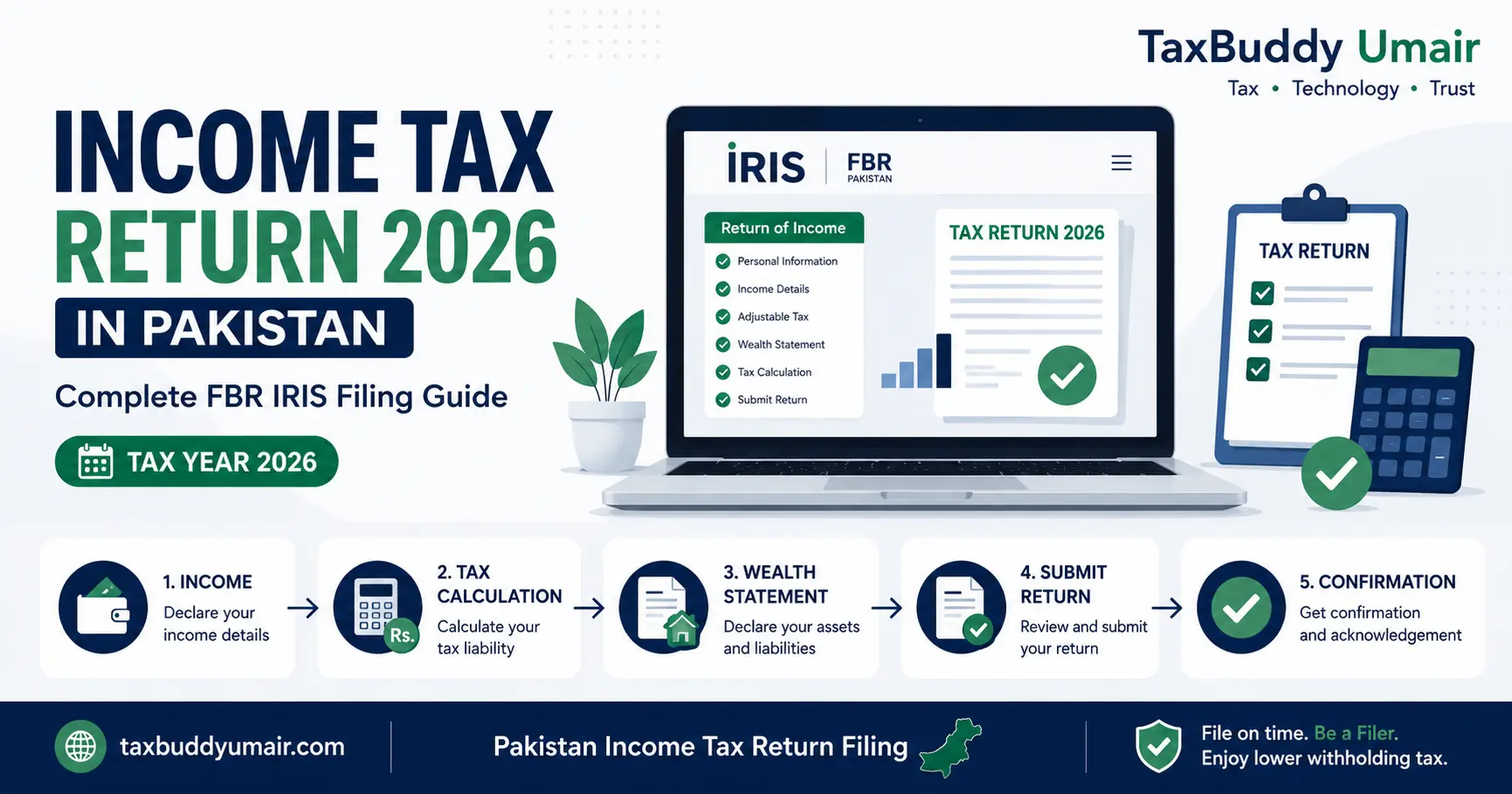
File Your Annual Income Tax Return
Log in to iris.fbr.gov.pk. Complete your income tax return for the relevant year, declaring all income, deductions, and tax credits. The return automatically calculates whether you have a tax payable position or a refund due. -
Declare All Withholding Tax Credits
In the return, declare all advance tax and withholding tax deducted during the year — salary tax, Section 151 bank deductions, Section 236C/236K property deductions, Section 236Y card deductions, and any other withholdings. -
Calculate Net Refund
The system automatically calculates: Total tax deducted minus Final tax liability = Refund due (or tax payable). If the result is a refund, it is declared in the return itself. -
Submit the Return
Submitting the return constitutes the formal refund application under Section 170 for standard withholding tax refunds. -
Track Refund Status
Monitor the refund status on IRIS. FBR may request additional information or verification. Respond promptly to any queries to avoid delays. -
Receive Refund by Bank Transfer
Approved refunds are transferred directly to the bank account registered with your NTN on IRIS. Ensure your bank account details are up to date in your FBR profile.
Frequently Asked Questions (FAQs)
Q1: Can I claim a refund if I never filed a tax return before?
You cannot claim a refund without filing a tax return. The return is both the self-assessment of your liability and the basis of your refund claim. File your return for the relevant year (even if late) to establish the refund entitlement. Late filing penalties may apply but the refund can still be claimed within the three-year window.
Q2: Does the Commissioner have the right to audit my accounts before processing the refund?
Yes. The Commissioner may select a refund application for audit before issuing the refund. If selected, you must cooperate and provide the required records. However, the audit and refund processing together must still be concluded within a reasonable period, and the Commissioner must provide you an opportunity of being heard.
Q3: If I have outstanding income tax dues, will my full refund be withheld?
Only the portion of the refund equal to your outstanding dues will be set off. The remaining balance (if any) will be refunded to you in cash. For example, if your refund is Rs. 50,000 but you owe Rs. 20,000 in another tax year, Rs. 20,000 is set off and Rs. 30,000 is refunded.
Q4: Is there any profit or compensation paid on delayed refunds?
Section 171 of the Income Tax Ordinance, 2001 provides for compensation on delayed refunds. If the Commissioner does not issue a refund within the prescribed period after it becomes due, the taxpayer is entitled to compensation at KIBOR rate per annum on the delayed amount. This is an important taxpayer right that is often not claimed.
Q5: Can I claim a refund for withholding tax from five years ago?
No. The three-year limitation period is strictly enforced. If more than three years have passed from the later of the assessment date or payment date, the refund application is time-barred. Always file refund claims promptly.
Q6: What documents should I keep to support my refund application?
Maintain: salary tax certificates from employer (Form 16), bank withholding certificates (Form A), property transaction documents and Section 236C/K deduction evidence, Section 236Y card deduction records from bank statements, and any correspondence with FBR regarding the relevant tax year. Keep all records for at least six years.
Conclusion
Section 170 of the Income Tax Ordinance, 2001 provides a comprehensive and legally enforceable framework for recovering excess income tax. Whether the overpayment arose from excess withholding tax on salary, bank profit, property transactions, international card payments, or advance tax — every rupee overpaid belongs to the taxpayer and can be reclaimed through the Section 170 process.
The key requirements are clear: file within three years, use the prescribed form, apply to the correct Commissioner, and maintain all supporting documentation. The Commissioner must decide within 60 days and issue a written order. If not satisfied with the decision — or if no decision is received — the taxpayer has full appeal rights under Section 127.
Do not leave your excess tax with the government. File your annual return, claim all withholding tax credits, and recover what is rightfully yours.
Disclaimer: This article is for educational purposes only and does not constitute professional tax advice. Tax laws are subject to change through Finance Acts and FBR notifications. Consult a qualified and FBR-registered tax practitioner for personalised guidance on your refund application.
Need help filing your income tax return or applying for a tax refund under Section 170? Contact Umair Mubeen — FBR-registered tax consultant based in Karachi. Return filing starts from PKR 2,000. WhatsApp: +92 333 248 2742


💬 Comments 0
No comments yet. Be the first to share your thoughts!
✍️ Leave a Comment
Your comment will be reviewed before publishing. Please keep it relevant and respectful.